Heavy Load Storage is more than placing large products on tall steel frames. It is a careful balance between load capacity, access speed, floor strength, safety, and future growth. For global buyers, the right system must support real operating conditions, not only attractive catalog specifications.
James A. Tompkins, a respected warehousing author and consultant, said, “The warehouse is the heart of the supply chain.” That view remains practical today. A heavy-duty pallet rack may suit standardized pallets, while cantilever racking works better for long steel profiles, timber, or pipes. Drive-in systems can increase density, but they may reduce product selectivity. Automated storage and retrieval systems can improve consistency, yet they usually require stronger planning, software, and maintenance support.
Details matter. A 3,000-kilogram bay needs verified beam ratings, stable uprights, suitable anchors, and a level concrete slab. Forklift turning space also affects the real storage capacity. In humid coastal facilities, corrosion protection deserves closer attention. In cold warehouses, materials and equipment may perform differently.
This guide compares ten major types of Heavy Load Storage for international buyers. It considers structure, applications, advantages, limitations, installation needs, and long-term value. No single option fits every warehouse. Some recommendations may remain imperfect without site data. That is worth admitting. Buyers should confirm engineering calculations, supplier experience, inspection procedures, and local safety requirements before ordering. A lower purchase price can become expensive when damaged beams, blocked aisles, or poor expansion planning appear later.
Heavy Load Storage: Definition, Functions, and Selection Criteria
Heavy load storage refers to systems designed for concentrated, high-weight goods, such as steel coils, machinery, building materials, and bulk pallets. Its functions extend beyond holding products. A suitable system improves floor utilization, controls retrieval paths, protects workers, and supports accurate inventory movement. Common options include selective pallet racking, drive-in racking, cantilever racks, mobile systems, mezzanines, and automated storage equipment.
Selection should begin with verified load data. Record unit weight, pallet dimensions, load height, turnover rate, and handling equipment. Then check clear height, aisle width, floor capacity, fire protection, seismic exposure, and local safety requirements. A rack rated for 2,000 kilograms per level may fail when loads are uneven or poorly positioned. Small details matter.
Grand View Research valued the global warehouse automation market at USD 18.61 billion in 2022. It projects a 16.1% compound annual growth rate through 2030. MHI’s 2024 Annual Industry Report also identifies technology investment and workforce pressure as major supply-chain concerns. These figures support automation, but they do not justify automatic selection. In field assessments, a manual rack can outperform an automated system when product variety is high and order frequency is modest. That judgment is imperfect. Recheck it using real movement data, maintenance access, future load growth, and documented inspections under applicable standards such as EN 15635.
Structural Categories of Heavy Load Storage Systems
Top 10 Types of Heavy Load Storage for Global Buyers
Structural Categories of Heavy Load Storage Systems
Heavy load storage begins with structure, not appearance. The frame must transfer pallet weight safely into the floor. Selective pallet racking offers direct aisle access and adjustable beam levels. Drive-in and drive-through systems reduce aisles by supporting pallets on deep rails. Push-back and pallet-flow designs improve density while keeping product movement organized.
Cantilever racks suit long materials, including steel tubes, timber, and irregular loads. Their arms need balanced loading and secure column anchoring. Double-deep racks increase capacity, but forklift access becomes less flexible. Mobile racks move along floor rails, creating compact layouts for cold rooms or document storage. Heavy-duty shelving works for boxed components and smaller industrial parts.
Mezzanine-supported systems add a working level above storage. They can expand capacity without extending the building footprint, but floor loading and emergency access require careful review. Automated storage systems use guided carriers, lifts, or shuttles within engineered frames. These designs can improve inventory accuracy, although software failures still need manual procedures.
Load paths matter.
A practical assessment checks pallet dimensions, center of gravity, impact risk, slab strength, and seismic conditions. Local standards also influence anchoring, aisle width, fire protection, and inspection routines. In real projects, the heaviest pallet is not always the hardest challenge. Uneven loads and careless forklift turns often create greater stress. No layout is perfect. Periodic inspections may reveal assumptions that looked reasonable during design.
Top Ten Heavy Load Storage Types for Industrial Applications
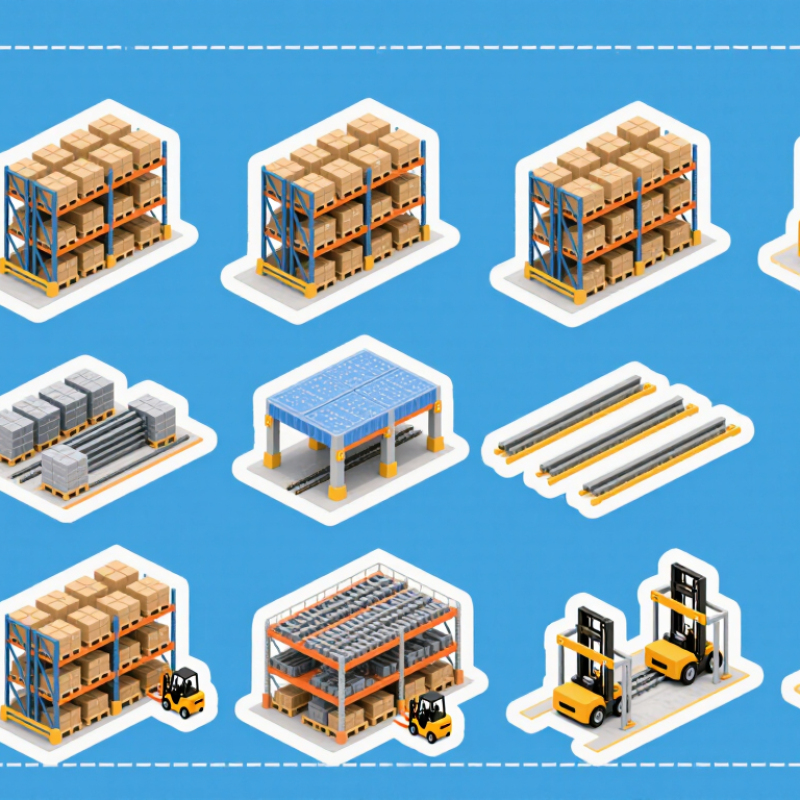
Industrial heavy-load storage starts with the load, not the aisle. The ten common types are selective pallet racks, drive-in racks, drive-through racks, push-back racks, pallet-flow racks, cantilever racks, double-deep racks, mobile racks, mezzanine-supported storage, and heavy-duty shelving. Each suits a different mix of weight, access, and turnover. Selective racks let forklifts reach each pallet directly. Drive-in systems pack pallets tightly, while pallet-flow lanes use gravity for first-in, first-out rotation. Cantilever arms hold long steel sections or timber without obstructing the front.
For block-stacked, uniform goods, floor storage may be simpler. Mobile racks can reduce aisle space, but access slows when equipment must move. Trade-offs matter. MHI’s 2024 Annual Industry Report surveyed more than 1,000 supply-chain professionals and found that 55% planned to increase investment in supply-chain innovation. That figure is not a rack-sizing rule; it signals pressure to make storage more responsive. Measure actual pallet loads, including packaging, before choosing beams. Check slab capacity, clear height, sprinkler clearance, and forklift turning radius on site. A rack that fits on paper can still fail operationally. This gets overlooked. Have a qualified engineer verify the design, and inspect frames for impact damage after installation.
Comparison of Capacity, Access, Safety, and Space Efficiency
Top 10 Types of Heavy Load Storage for Global Buyers
Heavy-load storage choices differ sharply in capacity, access, safety, and space efficiency. Selective pallet racks provide direct access to every load, but consume more aisle space. Double-deep racks increase density, although forklifts need longer reach and stricter load control. Drive-in racks maximize cubic capacity for uniform products, yet reduce selectivity and complicate stock rotation. Push-back and pallet-flow systems improve storage density while preserving faster loading patterns. Cantilever racks suit steel, timber, and long materials, but require careful balance and column protection. Heavy-duty shelving supports smaller components with safer hand access. Mezzanines add vertical capacity without expanding the building footprint. Mobile racks reduce fixed aisles, though movement systems need reliable maintenance. Automated storage systems can improve retrieval accuracy, but require higher capital and technical support. Every option has a cost.
Safety must remain measurable, not assumed. The U.S. Bureau of Labor Statistics recorded 885 fatal work injuries in transportation and warehousing during 2023, showing why traffic separation and inspection matter. OSHA 29 CFR 1910.176 requires stored materials to remain stable and secure. MHI’s 2024 Annual Industry Report also identifies labor pressure and productivity as major reasons for automation investment. In practice, capacity ratings depend on beam spans, floor strength, pallet condition, and impact history. Not all capacity is usable capacity. A dense layout can slow emergency access or increase collision exposure. Global buyers should compare clear aisle width, load visibility, retrieval frequency, fire protection, and local engineering requirements. The perfect rack rarely exists. Site data is often incomplete. That uncertainty deserves a contingency margin.
Global Buying Factors: Standards, Costs, Installation, and Suppliers
Top 10 Types of Heavy Load Storage for Global Buyers
For global buyers, heavy-load storage is not one product. Common choices include pallet racking, cantilever racks, drive-in systems, shuttle racks, mezzanines, mobile racks, stacker cranes, coil racks, tire racks, and floor-stacking frames. Each type changes aisle width, access speed, and floor loading. Standards must be checked before price comparison. Request rated capacities, deflection limits, anchoring details, welding procedures, and inspection records. Local building, fire, seismic, and workplace rules still control installation. An international test report helps, but it does not replace local approval. This matters.
Cost should include steel, shipping, duties, unloading, floor repairs, installation, inspections, and future adjustments. A cheap frame may require thicker slabs or special anchors. That difference appears late. Compare total ownership cost over five years, not only the quotation. Ask whether capacity covers evenly distributed loads or concentrated loads. Real pallets are rarely perfect. Moisture, forklifts, and repeated impacts can reduce service life. Include guards and replacement parts in the budget. Some estimates miss these details.
Installation needs accurate drawings, clear floor markings, and a method statement. Confirm ceiling height, forklift turning radius, sprinkler clearance, and delivery access. Suppliers should provide calculations, material certificates, training, warranty terms, and traceable spare-parts support. Check references from warehouses with similar loads and climate. Video calls are useful, but photographs cannot verify every weld. An independent inspection is worthwhile for high-bay or automated systems. I would also request written change-control procedures. Small revisions can affect stability. Do not rush this part.
Top 10 Types of Heavy Load Storage for Global Buyers
Typical rated load capacity by storage type, with global buying factors including standards, costs, installation, and supplier availability.
Selective pallet racking, drive-in racking, pallet flow racking, push-back racking, and mobile pallet racking are widely used for palletized heavy goods. The values show indicative engineering ranges expressed as typical tonnes per storage position or level; actual ratings depend on beam span, frame height, seismic conditions, floor capacity, load dimensions, and handling equipment. Buyers should verify compliance with EN 15635, RMI MH16.1, FEM guidance, or applicable local standards, while comparing delivered cost, installation requirements, inspection support, and regional supplier capability.
Data basis: representative industry ranges for standard heavy-load applications. These are planning figures, not a structural approval or product specification.
FAQS
It stores concentrated, high-weight goods such as steel coils, machinery, and bulk pallets. It also controls movement, protects workers, and improves floor use.
Record unit weight, pallet size, load height, turnover rate, and handling equipment. Uneven placement can weaken a rack rated for the stated weight.
Options include pallet racks, cantilever racks, drive-in systems, shuttle racks, and floor-stacking frames. Mobile racks, mezzanines, and automated systems may also fit.
Ask whether capacity covers evenly distributed or concentrated loads. Real pallets may lean, shift, or arrive with damaged boards. Small errors matter.
Check ceiling height, aisle width, floor capacity, sprinkler clearance, and forklift turning space. Seismic exposure and local safety rules also affect the design.
Not always. Manual racks may perform better with varied products and modest order frequency. Review movement data, maintenance access, and future growth before deciding.
Include steel, shipping, duties, unloading, installation, inspections, floor repairs, guards, and spare parts. Compare five-year ownership costs, not only the initial quotation.
Request accurate drawings, load calculations, material records, training details, and warranty terms. Mark the floor clearly and confirm delivery access. Do not rush this part.
Request references from warehouses with similar loads and climate. Ask for inspection records and written change-control procedures. Photos help, but they cannot verify every weld.
Schedule documented inspections under applicable local standards. Check anchors, frames, beams, guards, and signs of impact or corrosion. Recheck the design when loads change. I would not assume the original plan remains perfect.
Conclusion
Heavy Load Storage refers to engineered systems designed to safely organize, support, and access substantial loads in warehouses, factories, distribution centers, and other industrial environments. This article explains its core functions, including space optimization, inventory control, load protection, and operational efficiency. It also introduces the main structural categories, such as fixed, adjustable, mobile, automated, cantilever, and modular systems, while outlining how each design responds to different load sizes, weights, workflows, and facility conditions.
The article presents the top ten types of Heavy Load Storage for industrial applications and compares them by load capacity, accessibility, safety, flexibility, installation requirements, and space efficiency. It also highlights key factors for global buyers, including compliance with local standards, total cost of ownership, material quality, delivery conditions, installation support, maintenance, and supplier reliability. By evaluating both technical performance and long-term operating needs, buyers can select a storage solution that improves safety, maximizes usable space, and supports consistent industrial productivity.

 Guanlong Rack